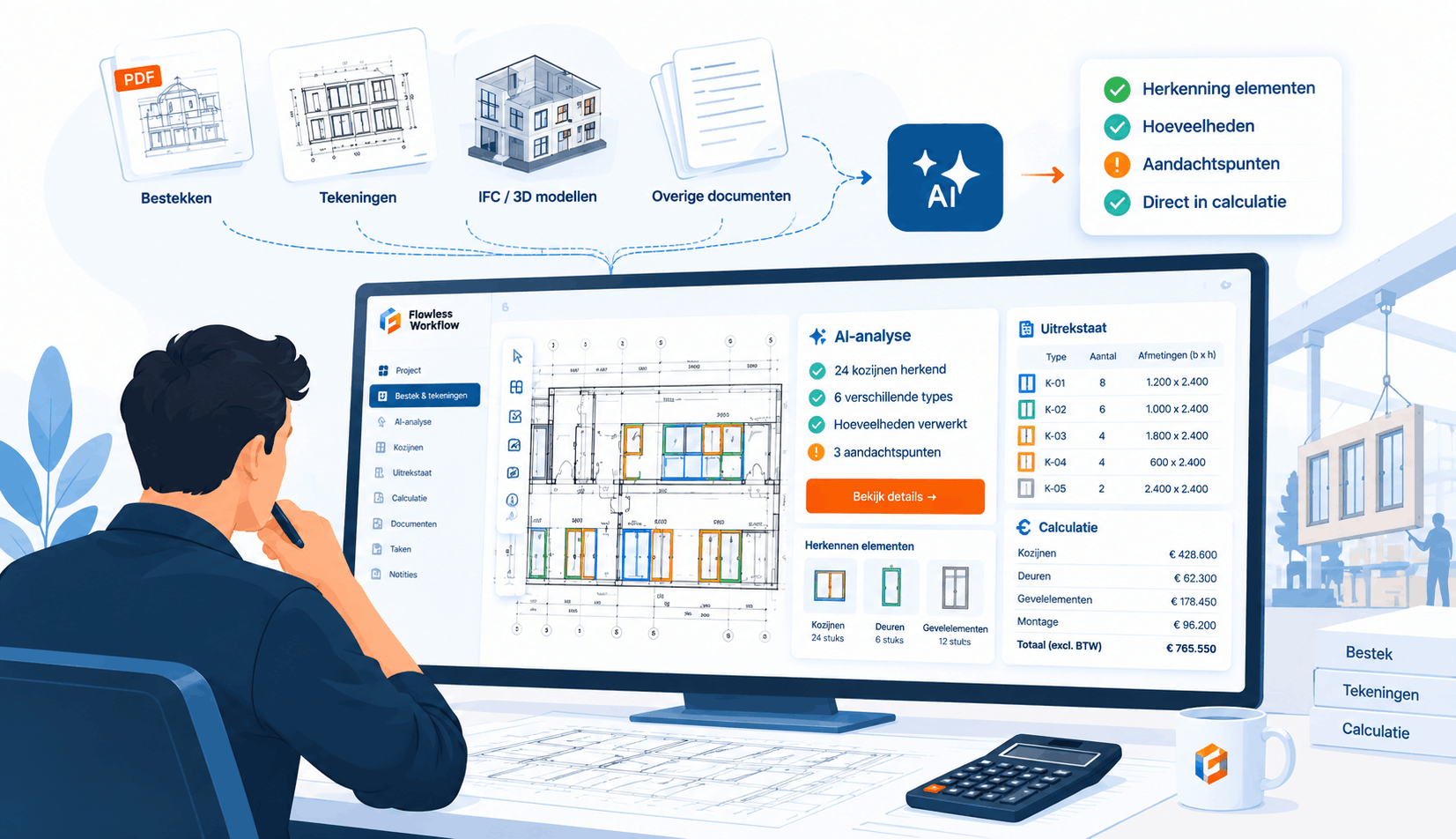
Creating a bill of quantities: automatically extract quantities with AI
Discover how to use AI to automatically generate a takeoff from drawings and specifications. The estimator always stays in control.
Faster from drawing to bill of quantities
For every estimator, it is part of the job: performing takeoffs from drawings. Counting quantities, measuring lengths and areas, and organizing it all neatly into a usable overview. It is precise work, but also repetitive and time-consuming. An AI-powered takeoff promises to take exactly that manual labor off your hands. In this blog, we explain what a takeoff is, why the process is prone to errors, and how AI helps with this.
What is a takeoff?
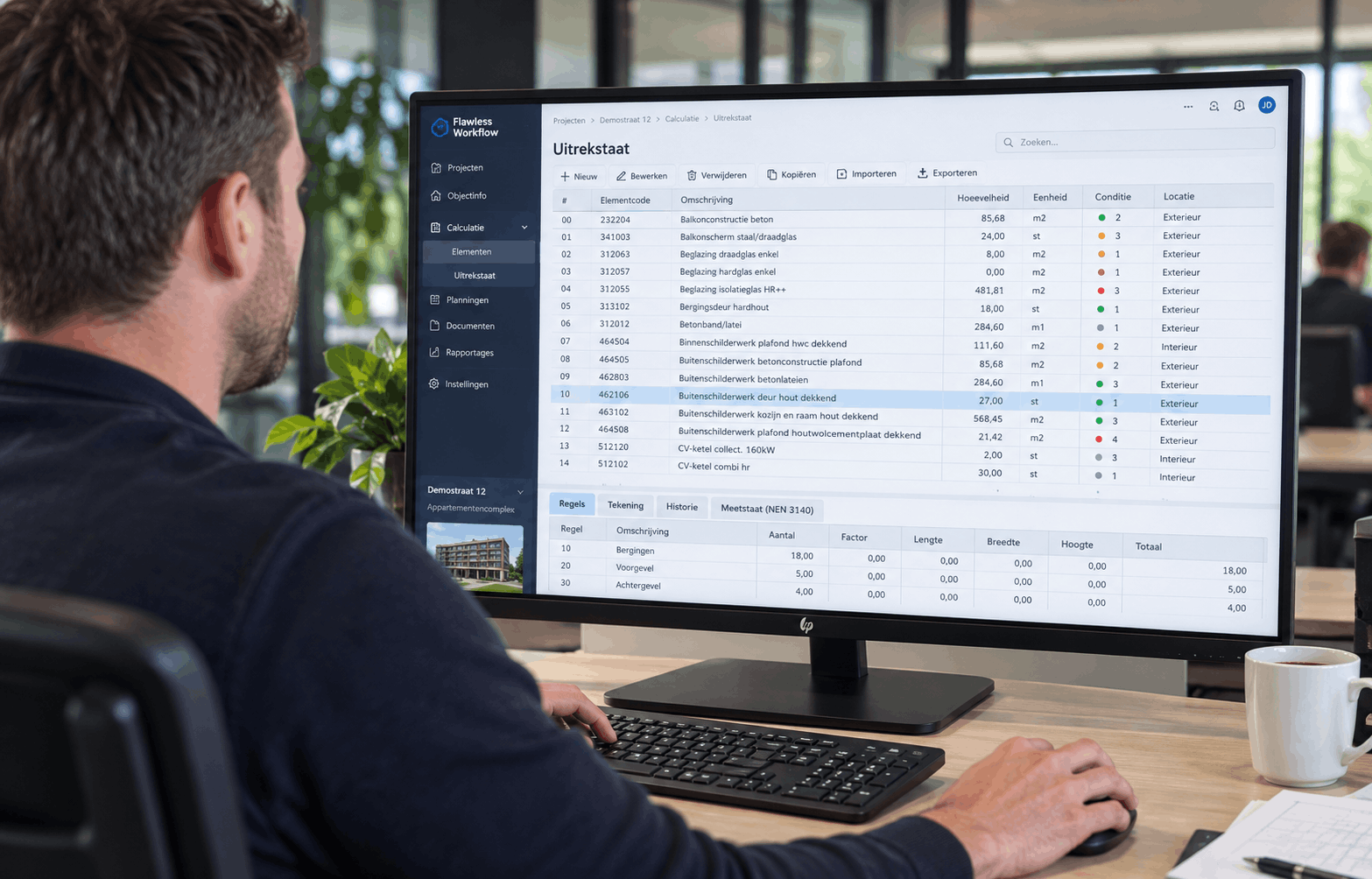
A takeoff is a structured overview of all quantities extracted from drawings and specifications: counts, lengths, areas, and volumes, organized by element or item. You may also encounter the term bill of quantities or measurement sheet. Whatever you call it, the function is the same: the takeoff serves as the bridge between the design and your estimate.
If the quantities are incorrect, that error carries through your entire budget. That is why a reliable, consistent takeoff is so important. And that is precisely where there is much to be gained with AI.
Takeoff, specifications, or estimate: what goes where?
These terms are often confused, even though they each serve a different purpose. It helps to keep them clearly distinguished.
Specifications define what needs to be done: the requirements, materials, and quality standards. However, specifications based on the widely used STABU system (managed by Ketenstandaard) generally do not provide quantities. Therefore, the number of window frames, meters of profile, or square meters of facade required is not listed. It is precisely those quantities that you, as an estimator, extract from the drawings yourself — that is your takeoff.
The estimate is the subsequent step where you assign prices to those quantities. If you want to delve deeper into that next step, read creating a cost estimate with AIIn short: the specifications say what, the bill of quantities says how much, and the estimate says what it costs.
Why quantity take-offs are so time-consuming and error-prone
Performing a take-off is trickier than it sounds. The necessary information is scattered across floor plans, elevations, and sections, and the same elements appear on multiple sheets. This means you have to constantly switch between drawings to avoid double-counting or missing anything.
Furthermore, manual measuring and retyping are inherently prone to errors. One incorrectly copied measurement and your bill of quantities is no longer accurate. Moreover, not everyone measures the same way, which can lead to two estimators arriving at different totals. That makes quite a difference compared to when you are estimating with AI.
Creating a bill of quantities with AI: how it works
When creating a bill of quantities with AI , the AI takes over the measuring and counting. The AI reads your drawings and specifications, recognizes the relevant elements, and compiles the quantities into a structured overview that you can review immediately.
From drawing to quantities
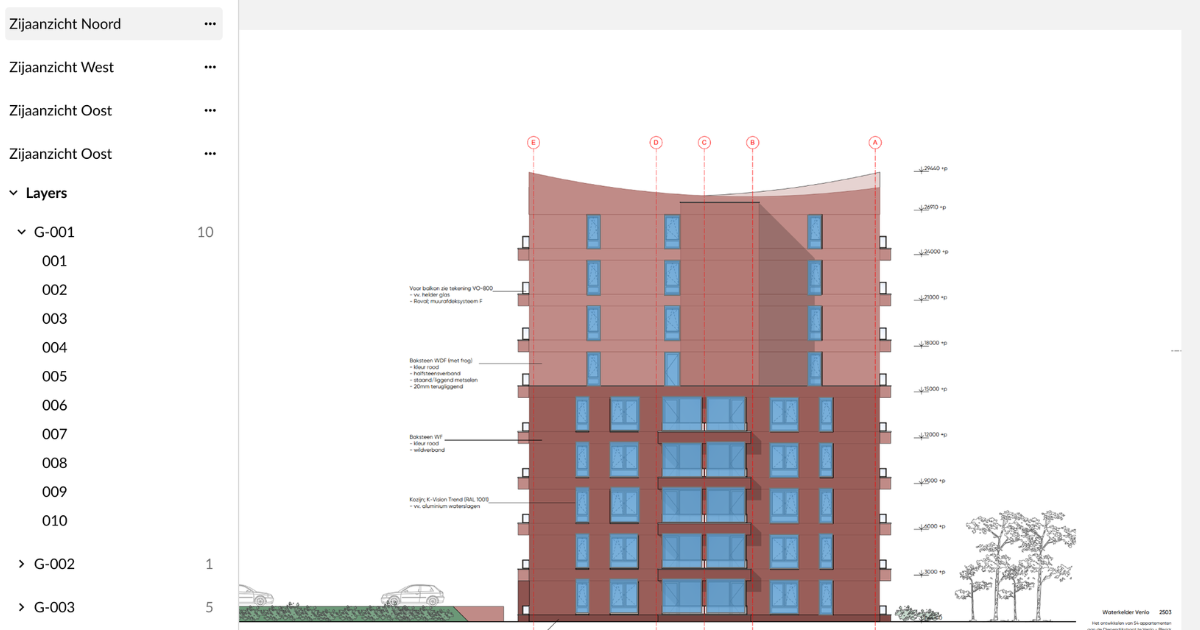
The AI identifies elements on the drawing and determines the corresponding counts, lengths, and areas. This shifts your role from counting and measuring to reviewing and correcting. The repetitive part of the work disappears, allowing you to focus on the items that really matter.
Comparing drawings and specifications
In addition to the drawings, the specifications remain relevant. Within the same platform, you can analyze both and verify that your extracted quantities align with the requirements and specifications. You can read more about that in analyzing construction drawings with AI.
Consistency: the same measurement rules, every time
By capturing your company context, the AI applies the same principles to every request. This makes your quantity takeoff more predictable and easier to justify, regardless of who handles the request.
From takeoff to estimate and quote
The takeoff does not stand alone. It is the foundation for the next steps in your process: from quantities to an estimate and, ultimately, a quote. When that first step is faster and more consistent, the rest of the chain benefits.
A window schedule is, for example, a specific takeoff for window frames; you can read about how that works in extracting a window schedule from your drawing with AI. If you want to understand why your final result sometimes differs from the initial estimate, then calculating construction costs is a good next step. And for the broader picture of AI in the estimating profession: estimating in construction.
The estimator remains in control
It is important to remember that AI does not replace the estimator. AI Agents handle the preparatory measuring and counting, after which the professional reviews, corrects, and determines what ultimately goes into the estimate. If you are unsure about a quantity, you go back to the source and judge for yourself what is correct.
This approach yields more than just time savings. Junior estimators don't have to extract all quantities from extensive drawings independently from day one; the AI presents the relevant data in a consistent structure. This makes knowledge easier to transfer and helps new colleagues grow faster. In short: the technology accelerates the takeoff process, while craftsmanship remains in the lead.
Conclusion takeoff sheet
Creating a takeoff sheet with AI does not mean you are handing over your profession. AI takes over the time-consuming, repetitive measuring and counting; you retain control over which quantities are included. The result is a takeoff sheet that is completed faster, is more consistent in its structure, and is easier to verify. This allows you to process more requests with the same team, without compromising on quality.
Curious about what this means for your estimation process? Schedule a free demo or discover how BuildIntake helps you extract quantities from your drawings faster.
Do you want to go from inquiry to project faster with AI?
Discover how BuildIntake helps subcontractors process inquiries smarter, select the right projects, and achieve more with the same team.
Related articles
Construction estimation software primarily helps with calculating costs, hours, materials, markups, and margins. AI assists by analyzing project information from various sources simultaneously and providing actionable input for the rest of the estimation process.