Construction estimation software: what changes with AI?
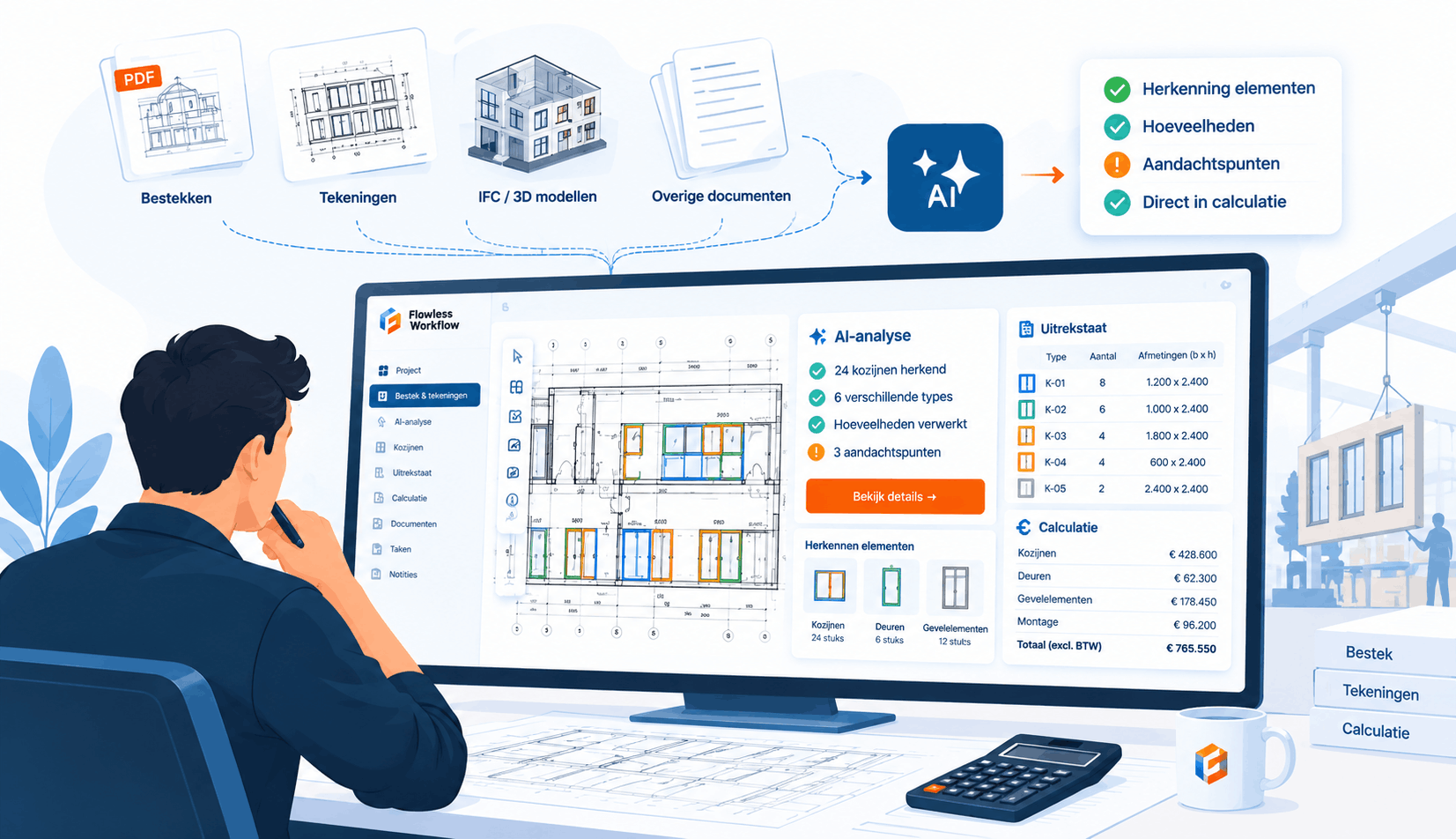
Construction estimation software primarily helps with calculating costs, hours, materials, markups, and margins. AI assists by analyzing project information from various sources simultaneously and providing actionable input for the rest of the estimation process.
Estimating in software
A construction estimation program helps estimators calculate costs, materials, hours, markups, and margins. For many construction companies, such software has now become indispensable.
Yet, a large part of the work is not in the calculation itself.
Before an estimator can even begin calculating, they often have to sift through specifications, check technical drawings, determine quantities, and identify risks. Project information is scattered across documents, drawings, Excel files, emails, and other systems.
This is exactly where AI is changing the estimation process.
With AI, more and more preparatory tasks can be supported or automated. Not to replace the estimator, but to ensure they spend less time on research and have more time left for actually assessing and estimating projects.
In this article, we explain what construction estimation software does, the limitations of traditional estimation software, and the role AI can play in the estimation process.
What is construction estimation software?
Construction estimation software is a tool that allows construction companies to calculate the costs and revenues of a project. The program helps bring different components of a project together into a single estimate.
Depending on the type of software, you can work with, for example:
- material prices;
- material quantities;
- labor hours;
- machine costs;
- subcontractor costs;
- surcharges;
- general expenses;
- risk premiums;
- margins;
- budgets;
- quotes.
Cost estimates and budgets often use fixed cost structures, such as the classification according to NEN 2699.
For many construction companies, the estimation software is the heart of the commercial process.
The estimator uses all available project information to ultimately arrive at a cost price and selling price.
But before that information can be entered into the estimation software, it must first be found, verified, and structured.
And that is precisely where a lot of time is spent in practice.
What does an estimator use estimation software for?
A traditional estimation process generally looks like this:
Request → gather project information → determine quantities → calculate → review → quote
The estimation software primarily plays a role from the moment the necessary project information becomes available.
For instance, the estimator must already know:
- exactly what falls within the project scope;
- which products or components are required;
- which quantities must be included;
- which materials are specified;
- which specific requirements apply;
- which risks are involved in the project.
The program is then excellent at helping with the calculations.
However, the information on which that calculation is based often still needs to be gathered largely by hand.
What are the limitations of traditional estimation software?
Traditional estimation software is usually designed to perform calculations accurately and reliably.
That is exactly where such programs excel.
The problem often lies not in the calculation itself, but in everything that precedes it.
1. Specifications still have to be combed through manually
When a new project request arrives, an estimator sometimes receives dozens or hundreds of pages of documentation.
These may contain important requirements regarding, for example:
- material selection;
- fire resistance;
- acoustics;
- dimensions;
- performance;
- colors;
- tolerances;
- execution conditions;
- scheduling;
- responsibilities.
The estimator must determine from all that information what is relevant to their own work.
This often means searching, reading, highlighting, checking, and comparing.
For larger requests, just reading and analyzing the specifications can take a lot of time.
2. Quantities must be extracted from drawings
In addition, it must be determined what actually needs to be supplied or executed.
For this, the estimator uses, for example:
- floor plans;
- elevations;
- sections;
- detail drawings;
- window and door schedules;
- PDF drawings;
- DWG files;
- IFC models.
Depending on the type of business, elements are counted, dimensions are checked, surface areas are determined, or objects are grouped.
This is still often done manually.
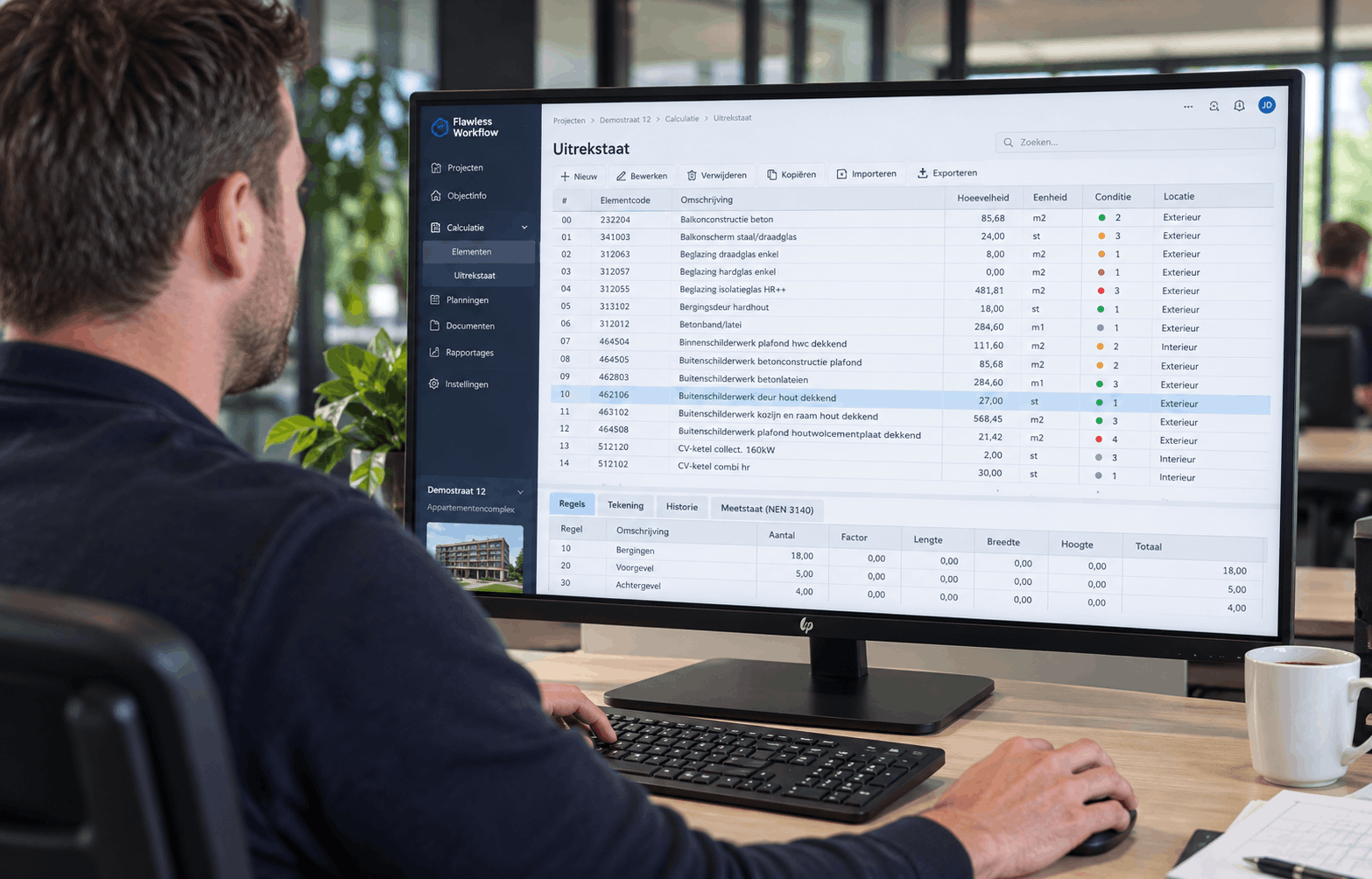
The estimator measures a drawing, notes quantities, and then processes them into a take-off list, bill of quantities, or estimate.
3. Project information is scattered
Another challenge is that the necessary information is rarely in one place.
The technical specifications say one thing.
A drawing shows something else.
An email contains an additional agreement.
And an earlier version of the quantities might be found in an Excel file.
The estimator has to gather that information and determine which source is definitive.
This not only takes time, but also increases the risk that information is missed or interpreted differently.
4. Even an inquiry you don't estimate costs time
Not every inquiry is interesting enough to actually estimate.
Perhaps the project doesn't fit within the available capacity.
Perhaps the technical complexity is too high.
Perhaps the chance of winning the contract is low.
Or the project simply isn't a good fit for the type of work the company excels at.
But to figure that out, the inquiry often still needs to be reviewed first.
This creates a difficult problem: even the decision to not estimate a project can already consume valuable estimating capacity.
5. A lot of knowledge resides with experienced estimators
Good estimators don't just know the estimating software.
They also know the company.
They know which projects are a good fit, which details often cause problems, which clients frequently request changes, and where margins can be lost.
That knowledge is incredibly valuable, but it also makes an organization dependent on a limited number of experienced employees.
When those same employees then spend a lot of time searching, counting, and checking, valuable expertise is being used for tasks that could be partially automated.
What does AI add to construction estimation software?
AI doesn't necessarily change the calculation itself.
The most significant change lies in how information is gathered, verified, and structured before the calculation even begins.
While traditional software primarily relies on information manually entered by the estimator, AI can help extract that data directly from project documentation.
This enables a new way of working.
Automatically analyzing specifications with AI
An AI system can analyze technical documents and structure relevant information.
For example:
- identifying requirements;
- selecting relevant passages;
- gathering technical specifications;
- flagging missing information;
- detecting inconsistencies;
- identifying project risks;
- linking information back to the original source.
As a result, the estimator no longer needs to review every document from scratch.
Instead, they can start with a structured analysis and then verify the accuracy of the information found.
This shifts the estimator's role from searching for information to evaluating information.
Reading technical drawings with AI
Technical drawings also contain a wealth of information required for an estimate.
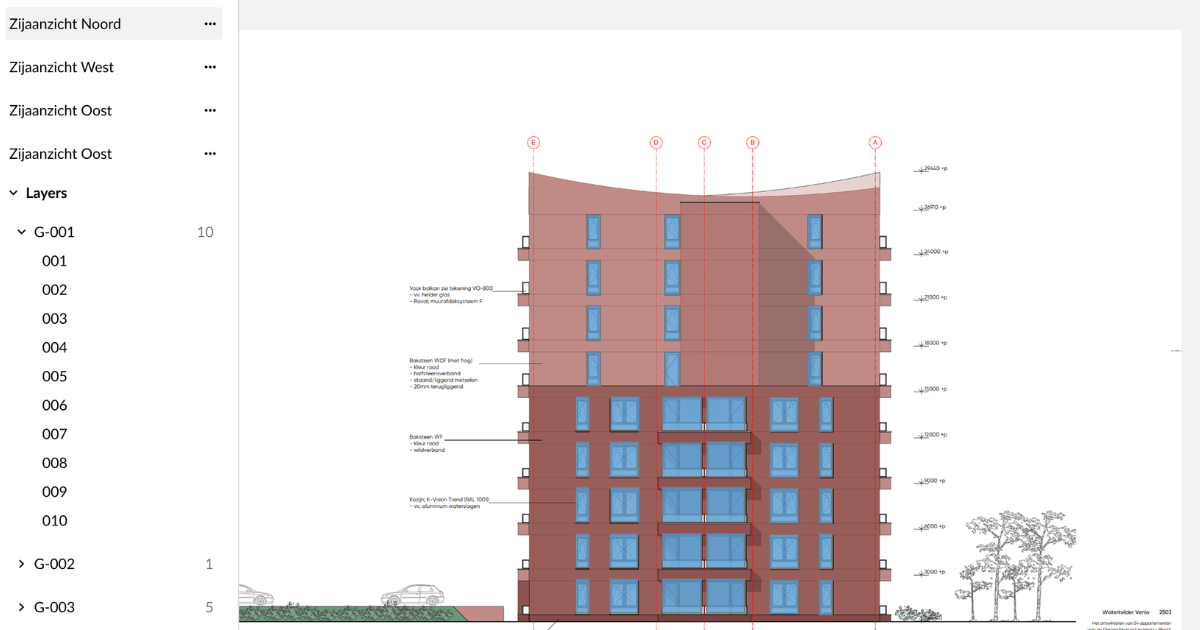
AI is becoming increasingly effective at identifying and structuring information from sources such as 2D drawings and IFC models.
Depending on the application, software can assist with tasks such as:
- recognizing objects;
- counting elements;
- determining positions;
- extracting dimensions;
- identifying spaces;
- calculating surface areas;
- grouping types or categories.
For a window frame manufacturer, this could mean, for example, that window frames from floor plans and facade elevations are automatically recognized.
For a finishing company, this could involve walls, ceilings, or entire rooms.
And for other manufacturers, different elements may be relevant.
AI does not need to determine the final calculation independently. The primary goal is to help the estimator arrive at usable and verifiable project information more quickly.
Automatically determine quantities
An important part of many construction estimates is determining quantities.
This is also known as quantity take-off.
For example, the estimator creates a:
- take-off list;
- bill of quantities;
- measurement sheet;
- material list;
- window and door schedule.
Traditionally, this data is extracted from drawings manually.
With AI, part of this work can be automated.
Software can, for example, recognize elements, collect counts, and structure this information into an initial quantity overview.
The estimator then verifies the output and uses it as a basis for the rest of the calculation.
This shifts the work from manual counting to check and assess.
Identify risks earlier
A good estimate is about more than just quantities and prices.
Risks are just as important.
Consider:
- missing data;
- conflicting documents;
- unclear responsibilities;
- deviating material choices;
- specific technical requirements;
- unclear scope;
- exceptions;
- scheduling risks.
Traditionally, many of these risks are discovered while the estimator is working through the documents.
AI can help make them visible earlier and more systematically.
This does not mean that AI decides independently whether a project is risky. However, it can point the estimator toward components that deserve extra attention.
Preparing quotes
Once project scope, quantities, and risks are structured, a better foundation for the bidding process is established.
AI can help with tasks such as:
- summarizing project information;
- structuring components;
- preparing standard text;
- gathering relevant exclusions;
- identifying project deviations;
- processing information from the estimate.
Commercial and content responsibility remains with the employee.
AI primarily ensures that less information needs to be manually transcribed.
Does AI replace your existing estimating software?
In many cases, no.
When a construction company is already using effective estimating software, there is little reason to replace that entire environment.
The greatest opportunity often lies in improving the process surrounding that software.
For example, an AI platform can collect information from documents and drawings and then make it available for:
- the estimating software;
- ERP;
- CRM;
- quotation process;
- project administration;
- work preparation.
This creates an integrated process.
Existing estimation software remains part of the workflow, while AI takes over some of the manual groundwork.
What is an AI estimation program for construction?
The term AI estimation program is being used more and more, but it can mean different things.
In practice, it refers to software that uses artificial intelligence to support parts of the estimation process.
This can go beyond just the calculations.
An AI-supported estimation process can, for example, help with:
- evaluating project inquiries;
- analyzing specifications;
- analyzing construction drawings;
- determining quantities;
- identifying project risks;
- preparing estimation input;
- reviewing quotes.
Benefits of AI in construction
AI can add value to the estimation process in several ways.
Less manual research
The most immediate gain is in repetitive tasks.
When software can find, structure, and prepare project information, estimators spend less time searching and transcribing data.
This leaves more room for tasks that require professional expertise and commercial judgment.
Increased estimation capacity
Skilled estimators are in short supply.
That is why it is not always realistic to manage growth simply by hiring more staff.
When the same employees spend less time on manual research, more capacity becomes available within the existing team.
This allows for more requests to be reviewed and estimated.
Reviewing more requests
A major consequence of limited estimation capacity is that companies cannot take on every request.
As a result, they must decide early on which projects to pursue and which to decline.
When AI assists with the initial analysis of an application, it becomes easier to quickly determine:
- is this project a good fit for us?
- do we have the right capacity?
- what risks do we see?
- what information is missing?
- is this project commercially attractive?
This allows available estimation capacity to be deployed more effectively.
Working more consistently
When every estimator reviews documents in their own way, discrepancies can arise.
For example, one employee might focus heavily on technical risks, while another looks primarily at quantities.
A standardized AI-supported workflow can help analyze applications more consistently.
The estimator remains responsible for the assessment, but starts every application from the same structured foundation.
Earlier insight into risks
By comparing information from various project sources, discrepancies can be identified sooner.
This can help flag risks before a bid is submitted, rather than later during work preparation or execution.
Can AI replace an estimator?
No. That is not the goal either.
Estimating requires much more than just extracting information from documents.
An experienced estimator understands, among other things:
- which projects are a good fit for the company;
- where commercial opportunities lie;
- which risks are acceptable;
- what margin is required;
- when assumptions are justifiable;
- when additional information needs to be requested from the client.
AI can help with gathering and structuring information.
The estimator remains the one who evaluates this information and makes the final decisions.
You can think of the distinction roughly like this.
AI helps with:
- searching;
- reading;
- structuring;
- comparing;
- counting;
- flagging.
The estimator remains responsible for:
- verify;
- interpret;
- commercial decisions;
- pricing;
- margins;
- risk assessment;
- client communication;
- final estimate.
The true value of AI lies in its combination with professional expertise.
How does BuildIntake work when it comes to estimation?
BuildIntake is not a traditional estimation program where you simply enter lines for materials, labor, and costs.
The platform focuses specifically on the process surrounding the estimate.
The premise is simple: all information regarding a project inquiry is brought together in one environment, and specialized AI agents assist in processing it.
1. Consolidating project information
A new inquiry can consist of various sources, such as:
- specifications;
- technical specifications;
- PDF drawings;
- DWG files;
- IFC models;
- Excel files;
- emails;
- supplementary documentation.
BuildIntake brings these sources together around the same request.
This allows the estimator to work from a single project environment.
2. AI agents analyze the request
Subsequently, various AI agents can perform specific tasks.
For example, consider an agent that analyzes the specifications or an agent that reads drawings.
Information from different sources is not treated as isolated silos.
A requirement from a specification, for instance, may be relevant to what is shown on a drawing.
Analyzing project information in context provides a much clearer picture of the request.
Depending on the process, the following can be structured, among other things:
- project scope;
- requirements;
- quantities;
- objects;
- deviations;
- risks;
- missing information.
3. The estimator checks and uses the output
The AI output is not the final step.
The estimator verifies the information and determines how it is used.
This information can then be used in the subsequent process, for example in:
- estimating software;
- ERP;
- CRM;
- the quotation process;
- work preparation.
The employee remains in control.
BuildIntake primarily supports the tasks that usually take up a lot of time before an estimator can actually begin their technical assessment.
Which construction companies can benefit from AI in estimating?
AI for estimating is particularly valuable for companies that process a high volume of project-based inquiries.
For example:
Window and facade builders
For window and facade projects, requests often consist of large volumes of drawings, technical specifications, and various types of elements.
AI can assist in identifying, gathering, and structuring this information.
Finishing contractors
Finishing contractors work with floor plans, spaces, walls, ceilings, and technical descriptions, among other things.
Determining quantities and verifying the project scope can be very time-consuming.
Prefab manufacturers
Prefab companies need to translate project information into manufacturable components.
Accurate quantities, specifications, and project requirements are essential for this.
Steel and construction companies
Here, too, drawings, technical specifications, quantities, and risks play a major role in assessing requests.
Other project-driven subcontractors
The same applies to virtually any subcontractor or construction supplier that needs to process a large amount of information before a price can be determined.
The greater the amount of manual research required, the more valuable automation becomes.
When is AI worth considering for estimation?
Not every company needs to overhaul its estimation process with AI immediately.
However, there are clear signs that automation could be beneficial.
For example, when:
- you receive more requests than your estimation department can handle;
- estimators spend too much time on specifications;
- drawings are measured manually;
- quantities have to be re-entered repeatedly;
- information is scattered across many files and systems;
- experienced estimators are hard to find;
- many requests are reviewed but never actually calculated;
- the same checks are performed for every single request;
- your existing estimation software works fine, but the process leading up to it remains slow.
In that last case, an AI solution doesn't necessarily mean you have to replace your existing software.
It can actually serve as a valuable addition.
How do you choose construction estimation software?
When looking for construction estimation software, it is tempting to focus primarily on comparing features and prices.
But a good program should, above all, align with the way your organization works.
Therefore, pay attention to the following points, among others.
1. Does the program suit your type of projects?
Estimating for window frames requires different information than estimating for interior finishing, mechanical engineering, or steel construction.
Therefore, check whether the software is well-suited to your specific field.
2. Can it integrate with existing systems?
An estimation program is rarely completely standalone.
Consider integrations with:
- ERP;
- CRM;
- accounting;
- project administration;
- planning;
- document management.
The less information that needs to be manually transferred, the more efficient the entire process becomes.
3. What happens before the estimation?
This is a question that is sometimes forgotten during software selection.
Do not just look at the calculation itself, but also at the steps required before the estimator can begin.
How are quantities received?
Who reads the specifications?
Who checks the drawings?
How are risks documented?
That is precisely where a lot of time can be lost.
4. Can the software process drawings?
For companies where drawings play a major role, this is becoming increasingly important.
Check which file types are supported and what information can actually be extracted from the drawings.
5. Can it analyze specification information?
The same applies to documents.
Can the software only store files, or does it actually understand and structure the content?
6. Is the output verifiable?
This is especially important with AI.
An estimator must be able to understand where information comes from and have the ability to verify and adjust results.
A system should support craftsmanship, not hide what is happening.
7. Can it grow with your process?
Maybe today you only want to read specifications.
But later you might also want to extract data from drawings, check quotes, or use project data for commercial decision-making.
Therefore, don't just look at your current problem, but also at your future workflow.
Estimation software and AI
Estimation software remains a vital part of the construction process.
It is the place where materials, labor, costs, overheads, and margins ultimately come together.
AI is primarily changing what happens before that stage.
Specifications no longer need to be combed through entirely from scratch.
Drawings can be analyzed more quickly.
Quantities can be prepared in advance.
Risks can be identified earlier.
And the estimator gets a structured overview of the request much faster.
In this way, AI doesn't necessarily change the role of estimation software, but it does transform the entire estimation process.
The question is therefore becoming less about:
“Which program can handle our estimates?”
And increasingly about:
How do we ensure our estimator can start with the right information as quickly as possible?
That is where the biggest opportunity lies for many construction companies.
BuildIntake: from inquiry to production, faster
BuildIntake was developed for the process from inquiry to contract.
Project information from sources such as specifications, drawings, and other documents is consolidated and analyzed by specialized AI agents.
The estimator remains in control and makes the decisions, but spends less time on repetitive research.
This allows the same team to process more inquiries and focus their available estimation capacity on the work where professional expertise makes the biggest difference.
Want to see how this works in practice? Request a BuildIntake demo today!
Sign up for our newsletter
Every month, we'll send you one email full of smart insights about data-driven work, AI applications and software choices that really help you.
Related articles