Analyzing STABU specification documents with AI
A STABU specification forms the basis of many construction projects, but processing it often takes estimators a lot of time. Discover what a STABU specification is, what information it contains, and how AI helps analyze specifications, drawings, and revisions for estimation.
STABU Specification
At first glance, a STABU specification appears well-organized.
Everything has its place. Chapters, paragraphs, and codes ensure that information is recorded according to a fixed structure. This is convenient for construction professionals, as they know that a specification is not just a collection of loose texts.
Yet, structure does not automatically mean that estimation becomes easy.
Because in practice, an estimator still has to go through the document themselves. They have to determine which requirements are relevant. They have to link it to construction drawings. They have to check whether specifications, details, and revisions align correctly.
And that's precisely where the work begins. Because a STABU specification is often part of a much larger whole. The specification states what is required. The drawings show where and how that is implemented. Appendices, revisions, and supplementary documents further complete it.
As a result, estimation often doesn't start with calculations, but with searching, interpreting, and checking.
What is a STABU specification?
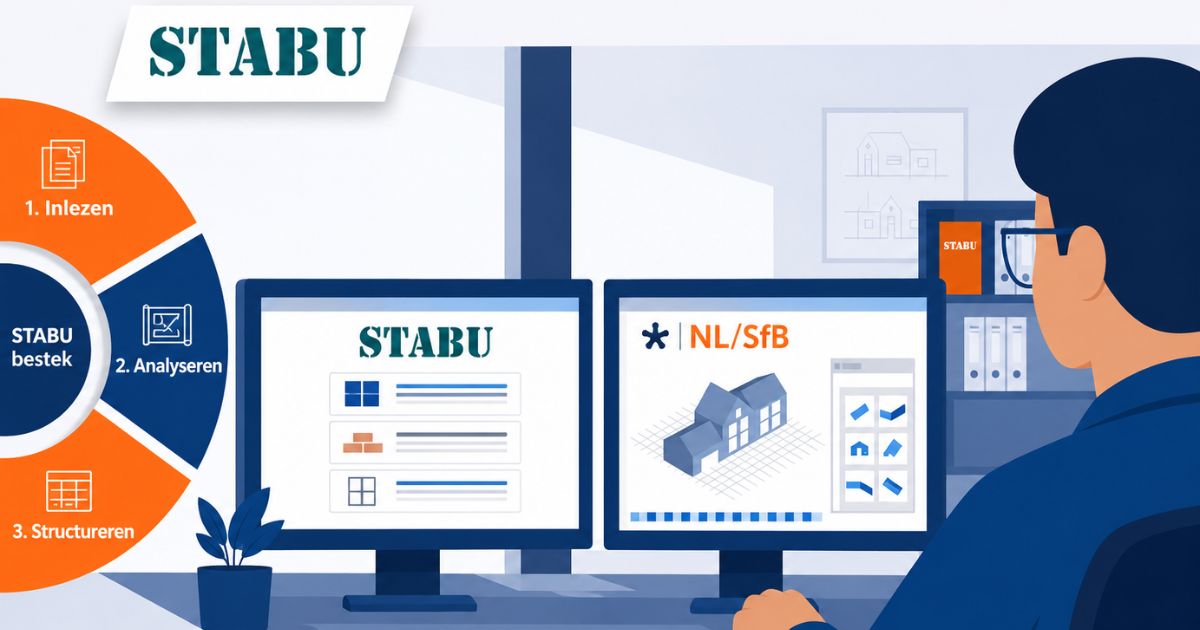
A STABU specification is a standardized specification document widely used in construction. This method is also known as the STABU specification system. It describes what needs to be built, which materials and performance are required, and under what conditions work must be carried out.
The strength of STABU lies in its structure.
Information is not recorded randomly but organized into chapters, paragraphs, and codes. This creates a recognizable structure for everyone working with the specification.
This is important for estimators, work planners, and contractors. They use the specification to determine:
- which activities are necessary
- which materials must be used
- what performance requirements apply
- what exceptions or conditions are important
- what risks need to be included in the calculation
So, on paper, a STABU specification provides a solid basis.
What information do estimators extract from a STABU specification?
An estimator reads a STABU specification differently than a client or architect.
The goal is not to read the entire document, but to quickly find the information that impacts the calculation.
In practice, this is often still done using CTRL+F. Estimators jump directly to the chapters, product groups, or requirements relevant to their part of the project.
- material specifications
- product specifications
- performance requirements
- fire resistance
- insulation values
- sound insulation
- waterproofing
- sustainability requirements
- certifications and quality marks
- installation conditions
- tolerances
- execution conditions
- exceptions
- risks
- contractual considerations
Ultimately, all this information must be translated into a calculation. And that's where the complexity lies, because a requirement in the specifications is only truly useful when it's clear what it pertains to. Which component? In which space? On which drawing? In what quantity? And with what exception?
Why STABU and construction drawings must be read together
A STABU specification often states what is required. A construction drawing shows where it is applied.
You cannot separate these two in a calculation.
For example, specifications might describe a performance requirement, while the drawing shows which components that requirement applies to. Or the drawing shows quantities, dimensions, and details, while the specifications determine the required quality, finish, or execution.
This means a calculator must constantly switch between:
- specifications
- construction drawing
- detail drawing
- revision
- appendix
- product specification
Why Revisions Pose Extra Risk
Something almost always changes in construction projects.
A material is adjusted. A detail is modified. A new drawing is added. A specification text is supplemented.
With every change, the impact must be re-evaluated.
This means:
- re-opening documents
- re-comparing
- searching for differences again
- re-determining what is relevant
- re-processing in the calculation
For STABU specifications, this can be particularly sensitive, as minor textual changes can have significant consequences for price, execution, or risk.
A modified requirement regarding fire resistance, insulation, assembly, or finishing can directly impact the calculation.
Therefore, revision processing is often one of the most time-consuming parts of the process.
How AI Analyzes STABU Specifications
AI can help to automatically analyze and structure STABU specifications.
Not by replacing the estimator, but by organizing the preparatory work more intelligently.
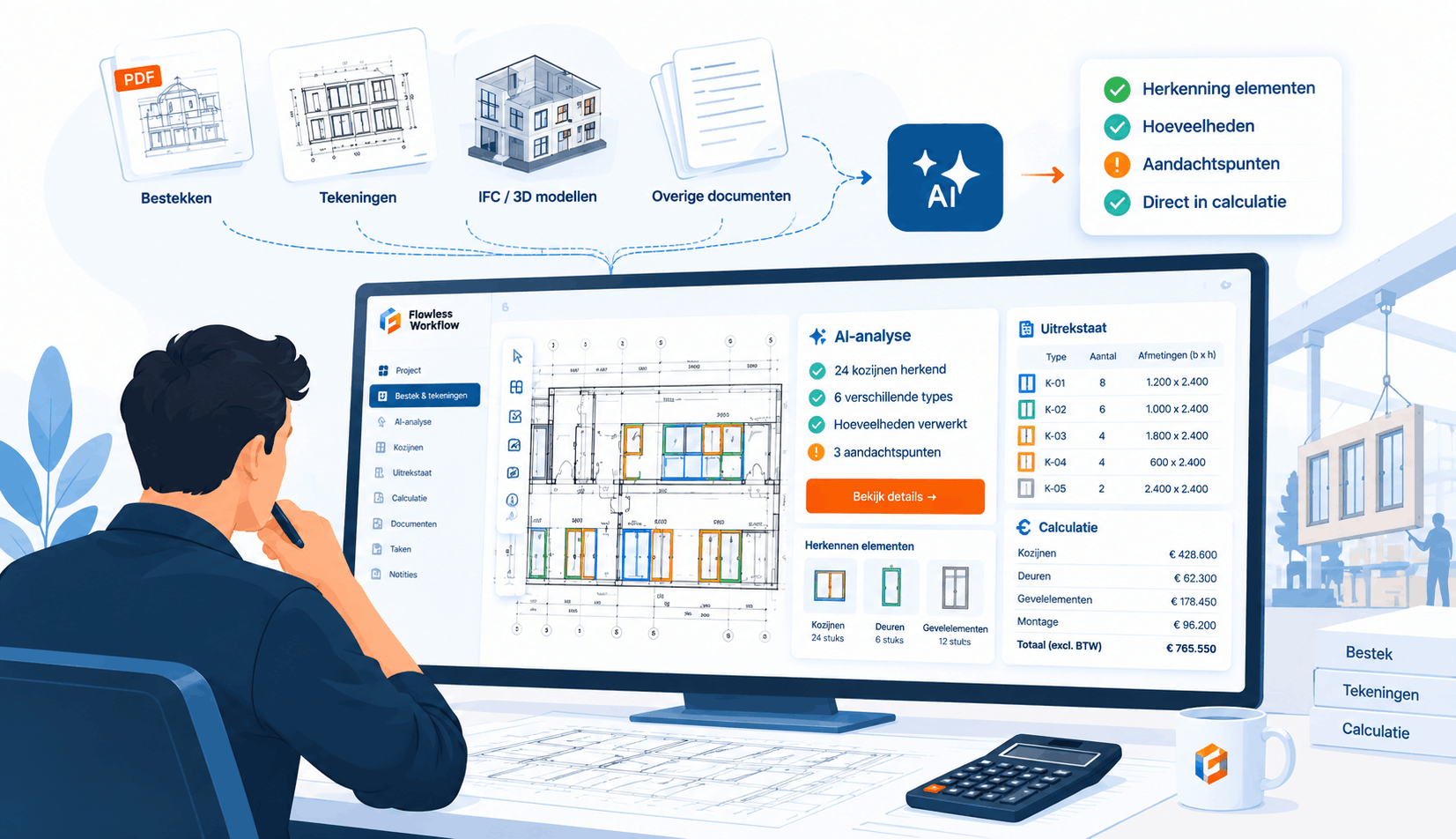
With AI, you can automatically extract, organize, and link relevant information from the specifications to other documents. This means an estimator no longer has to sift through hundreds of pages from scratch.
The Bestek Agent helps with, among other things:
- identifying relevant requirements
- structuring specification information
- linking specifications and drawings
- identifying inconsistencies
- processing revisions
- documenting sources
- converting information into a calculation basis
As a result, the work shifts from searching to assessing.
The estimator remains the one who checks, interprets, and decides. But they no longer start with disparate documents. They start with an overview where the most important information has already been compiled.
From STABU specifications to calculation basis
A different way of working starts with automatically structuring documents.
Instead of manually going through the entire specification first, the Bestek Agent can process the information into a clear calculation basis.
The process appears straightforward.
1. Upload documents
You upload the STABU specifications, construction drawings, revisions, and attachments as you receive them.
2. Select your desired output
You determine which information is relevant for your calculation. For example, requirements, quantities, materials, exceptions, or risks.
3. Receive structured output
The Specification Agent analyzes the documents and presents relevant information in an organized manner.
4. Start calculating immediately
You work from a consistent calculation basis, including source references, so you can always verify where information comes from.
What information AI extracts from STABU specifications
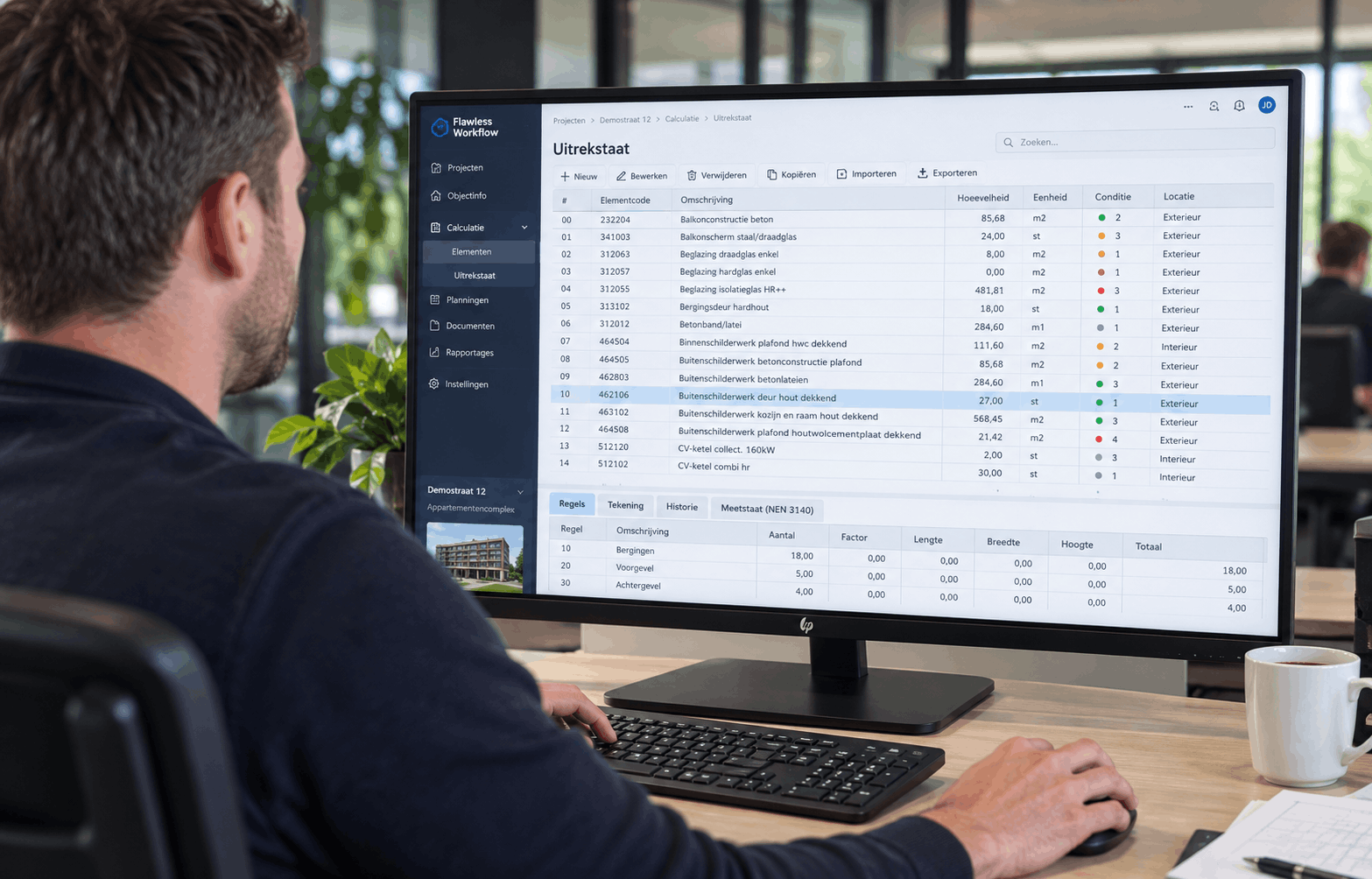
The Specification Agent can help identify and structure information such as:
- general project information
- material descriptions
- technical specifications
- performance requirements
- execution conditions
- fire resistance
- insulation values
- acoustic requirements
- water tightness
- tolerances
- quality marks
- certifications
- deviations
- risks
- contractual terms
- links to construction drawings
This provides quicker insight into what is relevant for estimation and work preparation.
How much time do you save with AI?
The main benefit of AI isn't solely about faster reading.
It primarily lies in reducing manual preparatory work.
Reading STABU specifications
Traditionally, understanding specifications takes a lot of time, especially when the document is large and relevant information is scattered.
With AI, relevant information is pre-structured, allowing the estimator to quickly assess what is important.
Comparing specifications and drawings
Normally, an estimator has to manually switch between specifications, drawings, and appendices.
The Bestek Agent helps to automatically link requirements from specifications to components in drawings and project documentation.
Process revisions
When changes occur, the entire process doesn't need to be restarted.
New versions of documents can be re-analyzed, making differences and relevant changes visible more quickly.
Identify risks
AI can help identify inconsistencies, missing information, and discrepancies between documents.
As a result, risks become apparent earlier and can be more consciously factored into the estimation.
Which companies is this interesting for?
AI for STABU specifications is particularly interesting for construction companies and construction suppliers who work daily with extensive project documentation.
Examples include:
- window frame manufacturers
- facade contractors
- steel construction companies
- roofers
- finishing contractors
- interior fit-out companies
- contractors
- work preparation teams
- estimating departments
For these companies, the benefit often lies not just in faster estimating, but primarily in better control over information.
Less searching. Fewer interpretation differences. More consistency in the output.
Conclusion: STABU Specification
A STABU specification provides structure to construction information.
But that doesn't mean estimating is automatically easy.
Estimators still need to consolidate information from specifications, drawings, revisions, and appendices. And it's precisely this preparatory work that takes a lot of time.
AI & AI agents change that process.
By automatically analyzing STABU specifications, structuring relevant information, and linking it to construction drawings, a consistent estimating basis is created.
Not as a replacement for the estimator, but as support before the estimating process begins.
This way, estimating no longer starts with searching, but with insight.
Discover the Specification Agent
Do you want to know how AI helps analyze STABU specifications, construction drawings, and revisions?
Discover how the Specification Agent automatically processes documents into a structured estimating basis.
Schedule a demo and test it on your own specifications.
Do you want to go from inquiry to project faster with AI?
Discover how BuildIntake helps subcontractors process inquiries smarter, select the right projects, and achieve more with the same team.
Related articles