Calculating construction costs: why your results often vary
Construction cost estimation might seem like it's all about the math. Yet, most discrepancies arise even before the calculation begins. In this article, you will learn where those differences come from and why consistent input is more important than perfect input.
What is a construction cost estimate?
A construction cost estimate is the process of determining all expected costs for a building project. It serves as the basis for a quote or budget used to secure a project.
This includes looking at factors such as:
- material costs;
- labor hours;
- equipment;
- subcontractors;
- transport;
- risk contingencies;
- overhead and profit.
Ultimately, this calculation forms the financial foundation of a project.
Yet, a reliable estimate does not start with these figures.
It starts with the information these figures are based on.
Why construction costs often deviate
Many organizations believe that discrepancies occur because of calculation errors.
In practice, the cause usually lies elsewhere.
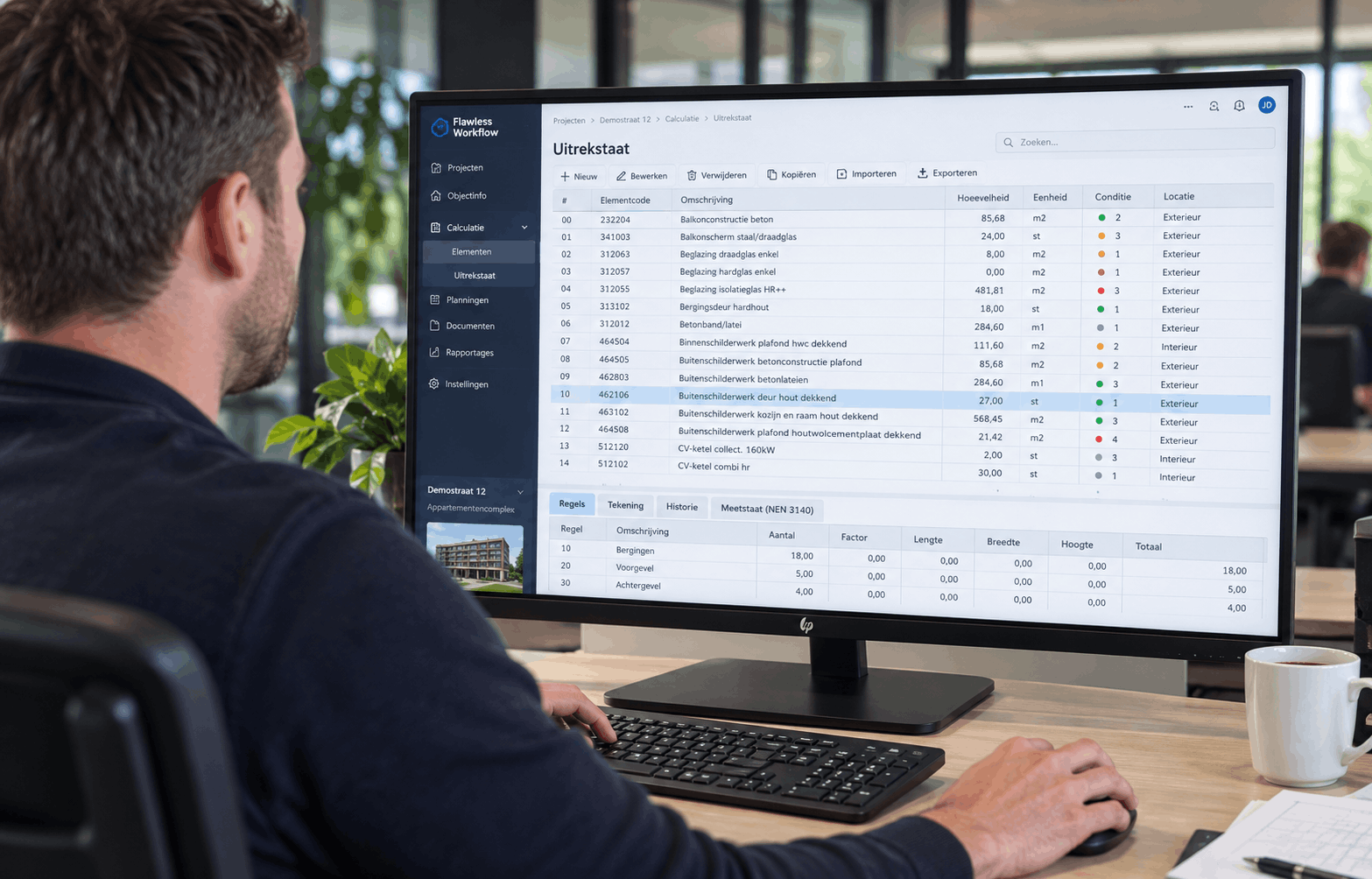
During the estimation process, estimators must process large amounts of project information. Specifications, construction drawings, revisions, memoranda of information, and contract documentation all need to be read, interpreted, and compared with one another.
It is precisely during this process that discrepancies arise.
A requirement is overlooked.
A revision is missed.
A detail on a drawing turns out not to match the specifications.
Or two estimators interpret the same information slightly differently.
The final construction cost estimate is therefore not only dependent on the calculation itself, but primarily on the quality and completeness of the information that precedes it.
The biggest mistake happens before the calculation
When people think of estimating, they often think of crunching numbers.
But an experienced estimator spends a large part of their time not calculating at all.
Most of the time is spent on:
- searching through specifications;
- analyzing construction drawings;
- comparing documents;
- checking project requirements;
- gathering quantities.
Only then does the actual calculation begin.
This also means that it is precisely in this preparatory phase that the most time is lost.
And that is often where the biggest differences between projects arise.
Not because estimators aren't doing their jobs well, but because the amount of information is constantly growing and projects are becoming increasingly complex.
Read also: Construction estimating: what AI can do for you
Perfect input doesn't exist
Many organizations try to improve their estimating process by checking documents even more meticulously.
That seems logical.
But in practice, project information is almost never complete or final.
During a project, specifications change, drawings are revised, and new versions of contract documentation appear.
Therefore, perfect input doesn't actually exist.
So the question isn't how to get perfect documents.
The question is how to ensure that every estimator works with that information in a consistent way.
When everyone works from the same structure, estimates become more predictable, the risk of errors decreases, and it becomes easier to safeguard knowledge within the organization.
Consistent output is ultimately more important than perfect input.
Want to know why so many errors occur specifically when reading specifications? Then read: Reading specifications without errors: how to approach it
How AI helps calculate construction costs
The preparatory work involved in cost estimation is particularly well-suited for automation.
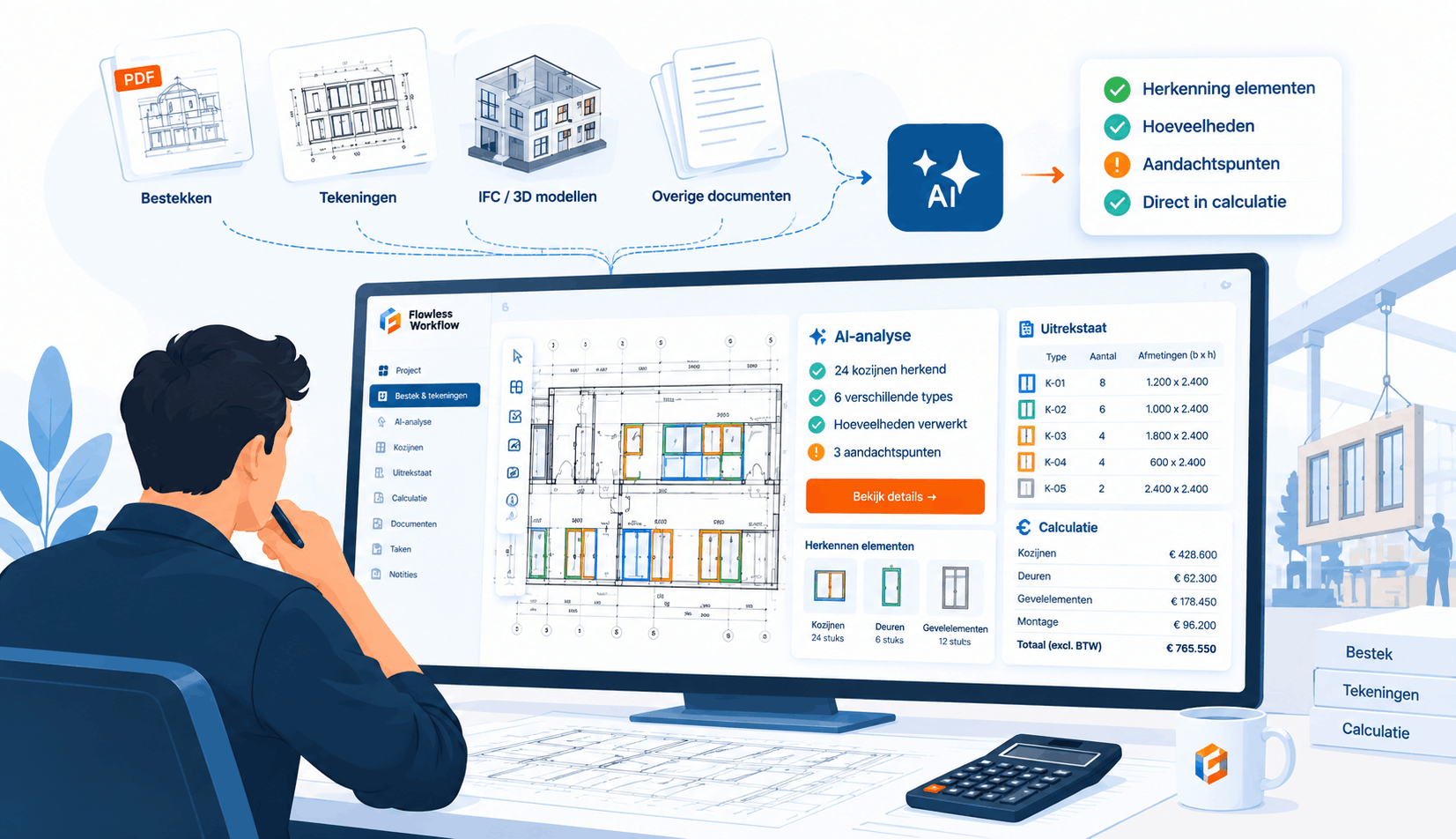
AI can automatically analyze specifications, construction drawings, and project documentation, structuring the relevant information before a cost estimator even begins their work.
Instead of manually searching through hundreds of pages, you immediately get an overview of:
- project requirements;
- materials;
- quantities;
- dimensions;
- spaces;
- discrepancies between documents.
The estimator remains responsible for the final assessment, but no longer has to start with a pile of PDF files.
They start with a consistent and verifiable information base.
This makes it possible to:
- process more requests;
- calculate more consistently;
- be less dependent on individual experience;
- gain faster insight into project risks.
So, AI does not replace the estimator.
Instead, it automates the most time-consuming part of the process.
Want to see how AI automatically reads construction drawings?
AI can automatically analyze specifications, construction drawings, and project documentation, structuring the relevant information before a cost estimator even begins. Instead of manually searching through hundreds of pages, you get an instant overview of project requirements, quantities, dimensions, and discrepancies between documents.
The estimator remains responsible for the final assessment, but no longer starts with a pile of PDF files. They start with a consistent and verifiable information base.
Curious about how AI automatically recognizes construction drawings, determines quantities, and reads dimensions? Then read our blog Analyzing construction drawings with AI:
https://flawlessworkflow.com/blog-posts/bouwtekeningen-analyseren-met-ai
Do you work with STABU specifications often? Then our blog Analyzing STABU specification documents with AI is also interesting. There, we show how AI automatically structures project information and converts it into a consistent foundation for every estimate:
https://flawlessworkflow.com/blog-posts/stabu-bestekdocumenten-met-ai-analyseren
Conclusion on calculating construction costs
Calculating construction costs is about much more than just crunching numbers.
The quality of an estimate is largely determined by how project information is collected, interpreted, and verified.
That is precisely where the biggest differences between organizations arise.
Anyone trying only to calculate faster is not solving the underlying problem.
Organizations that automate the preparatory process create a consistent foundation for every estimate. As a result, they can process more requests, submit quotes faster, and produce more reliable construction cost estimates.
Do you want to go from inquiry to project faster with AI?
Discover how BuildIntake helps subcontractors process inquiries smarter, select the right projects, and achieve more with the same team.
Related articles