Improving customer relationships: the power of a customer portal for B2B companies
Did you know that having a customer portal can be a real game changer for B2B companies? In this blog, we'll discuss its many benefits.

For B2B companies, a strong customer relationship is critical to long-term success. Creating a customer portal can be a real game changer here. This is because it serves as a secure, centralized environment that promotes effective communication, streamlines processes and improves collaboration. Curious about all the benefits of a customer portal? In this blog, we list them for you.
1. Efficient workflows and process optimization
First of all, a customer portal facilitates a streamlined workflow for both the organization and its customers. A customer portal makes efficient project management possible by centralizing tasks, deadlines and project-related documents. By allowing customers to provide input and feedback in real time, delays are prevented and projects can stay on track. This saves valuable time for both parties. Creating a customer portal offers many benefits in terms of workflows and process optimizations, of which a number of more specific examples will be highlighted in the following paragraphs.
2. Seamless communication and information exchange
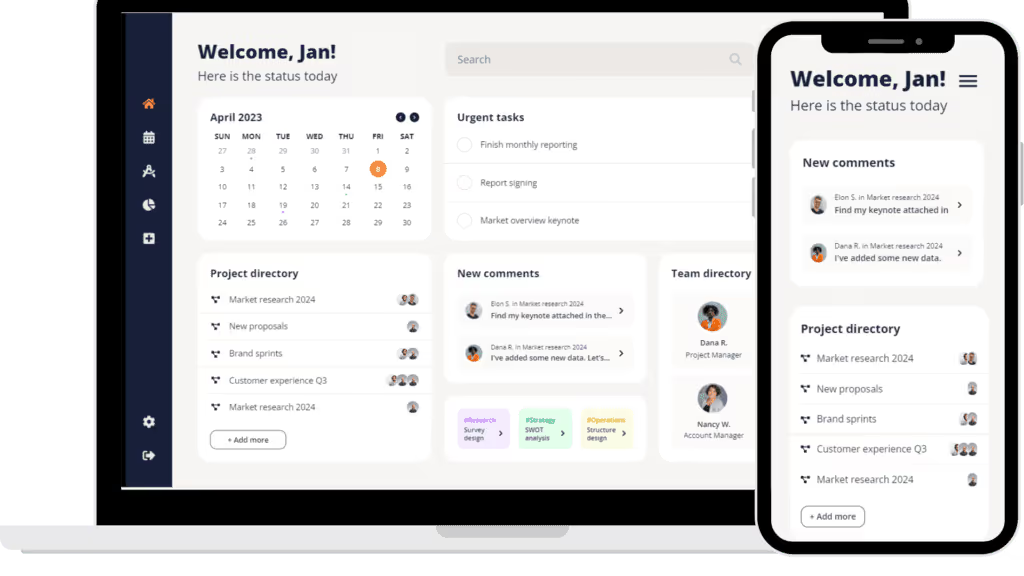
A customer portal facilitates efficient communication between your company and your customers. This is because it offers a centralized platform where you can exchange information, share documents with each other and work together on projects. This has several advantages. For example, sending and storing all kinds of emails in different places and having different file versions of documents are no longer necessary and you can avoid confusion. In addition, it ensures that all stakeholders have access to the most up to date information, promoting transparency and reducing miscommunication.
3. Optimal customer experience
With a customer portal, you therefore optimize the customer experience. For example, you can offer self-service options and personalized access to information related to the specific customer. Customers can easily access project updates, track progress, view invoices, and submit requests. This saves them time and effort and shows them that you, as a company, really care about meeting your customer's needs. And they will certainly appreciate that great service!
4. Connection between the customer portal & ERP system
Connecting the customer portal to the ERP system offers several advantages for both the organization and its customers. This is because the customer portal acts as a bridge between the customer and the ERP system, allowing important processes to be seamlessly automated. For example, customers can easily request quotes, place orders and manage invoices in the customer portal, while the link to the ERP system ensures efficient processing of this data. This not only reduces the time required for administrative tasks, but also minimizes the risk of human error that can occur during manual data entry. In addition, live insights into the organization, such as inventory and the logistics process, can also be linked. This creates an optimized system that ensures smoother business operations and improved customer satisfaction. Linking your customer portal to your ERP system is therefore a strategic choice that alleviates the administrative burden and offers an error-free experience for both the organization and your customers.
5. Offering customized products
Another advantage of having a customer portal is that it simplifies product customization, i.e. offering customized products. Indeed, by using a customer portal, B2B companies can offer their customers a personalized experience, allowing them to customize products themselves to their specific needs and preferences. Whether it's selecting certain features, adjusting specifications or choosing materials, the customer portal enables companies to provide customized solutions. This way, you can distinguish yourself from competitors and increase the satisfaction and loyalty of your customers.
6. Secure data traffic
Something you might not immediately think of when it comes to a customer portal, but is still incredibly important, is data security: a critical concern for many companies at the moment. A customer portal provides a secure environment for storing and sharing sensitive information. With appropriate authentication measures and encrypted data transfer, you can ensure your customers that their confidential data is properly protected. This builds trust and strengthens your customer relationships, especially in sectors with strict privacy regulations.
7. Analysis and Reporting
Understanding your customers' needs, preferences, and behavior is key to delivering personalized experiences. A customer portal can integrate analysis and reporting capabilities, providing valuable insights into customer interactions, usage patterns, and engagement metrics. In this way, informed decisions can be made and the customer's needs can be proactively addressed.
In short, a customer portal offers many advantages for both the organization itself and its customers. It is therefore highly recommended to make this part of your B2B strategy. Because by using the power of technology to promote collaboration and streamline processes, you're positioning your B2B company as a trusted sustainable partner that prioritizes customer success.
Do you also want to take advantage of the benefits of a customer portal and thus take your customer relationships to an even higher level? We'd love to help you out! Schedule an appointment with one of our consultants to see together what we can do for you. Want to see more of the customer portals we've created? A number of examples are highlighted below, we would like to explain them during an introduction!
Sign up for our newsletter
Every month, we'll send you one email full of smart insights about data-driven work, AI applications and software choices that really help you.
Related articles